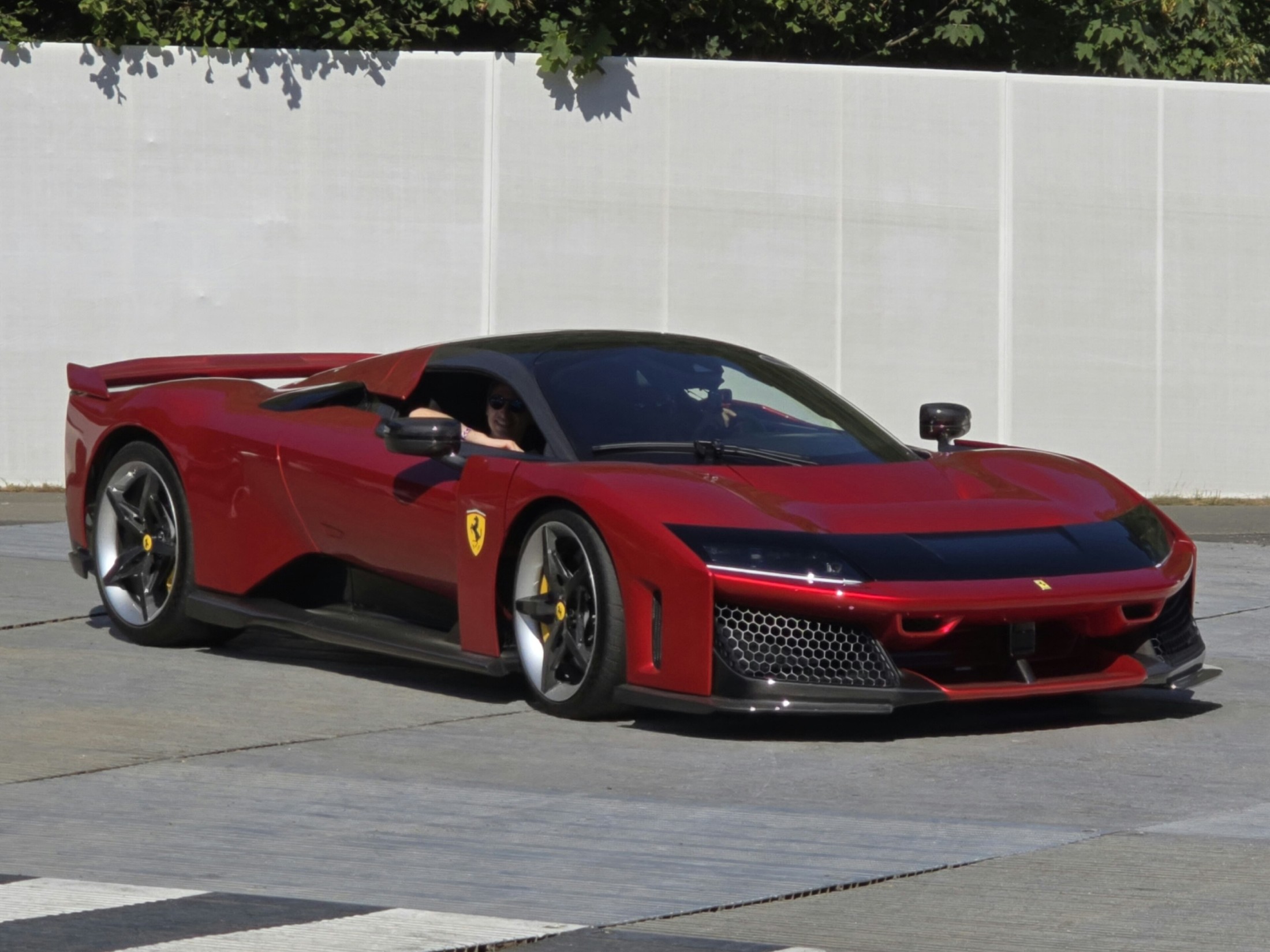
FERRARI redraws the top of its range roughly once a decade: the F40 in 1987, the F50 in 1995, the Enzo in 2002, LaFERRARI in 2013. The F80 takes the name from that lineage but not the recipe. At its centre sits a 3.0-litre V6, not a V12 and not a V8. That choice is the argument the car makes.
The twin-turbo V6 produces 900 hp on its own, and three electric motors bring the system total to 1,200 hp (883 kW) — two on the front axle, one at the rear. FERRARI claims 2.15 seconds to 100 km/h, 5.75 seconds to 200 km/h and 350 km/h at the top. The battery holds only 2.3 kWh but runs at 800 volts, recovering energy for repeated bursts rather than long electric range.
Aerodynamics define the car. At 250 km/h it generates 1,050 kg of downforce through an active rear wing, flaps under the nose and tunnels in the floor. In track mode the suspension drops 15 mm and the wing opens fully. A carbon monocoque with aluminium subframes keeps dry weight at 1,525 kg.
The cockpit is built around the driver. FERRARI abandoned LaFERRARI's fixed passenger position for a single-seat-in-the-middle feel: instruments sit at eye level and physical buttons remain on the wheel. The seats use carbon shells trimmed in fabric, each holding its occupant in place.
Production is capped at 799 cars, with a price reported around 3.6 million euros and every build already allocated. What FERRARI emphasises is not the power figure but the ratio behind it: the weight needed to manage 1,200 hp, the downforce needed to support that weight, and the shape needed to make that downforce. The F80 is those three numbers stated as a car.
要点
- The F80 was unveiled in 2024 as FERRARI's hypercar successor to LaFERRARI
- A 3.0-litre twin-turbo V6 plus three electric motors produce 1,200 hp (883 kW) combined
- 0 to 100 km/h in 2.15 seconds and a 350 km/h top speed
- Aerodynamics generate 1,050 kg of downforce at 250 km/h
- Production is limited to 799 cars
如认为本文与事实不符,可依更正与答辩程序提出请求。联系邮箱 press@mbent.co.kr。
下一篇 · MOTORS FERRARI DAYTONA SP3: 1967 brought back to life →