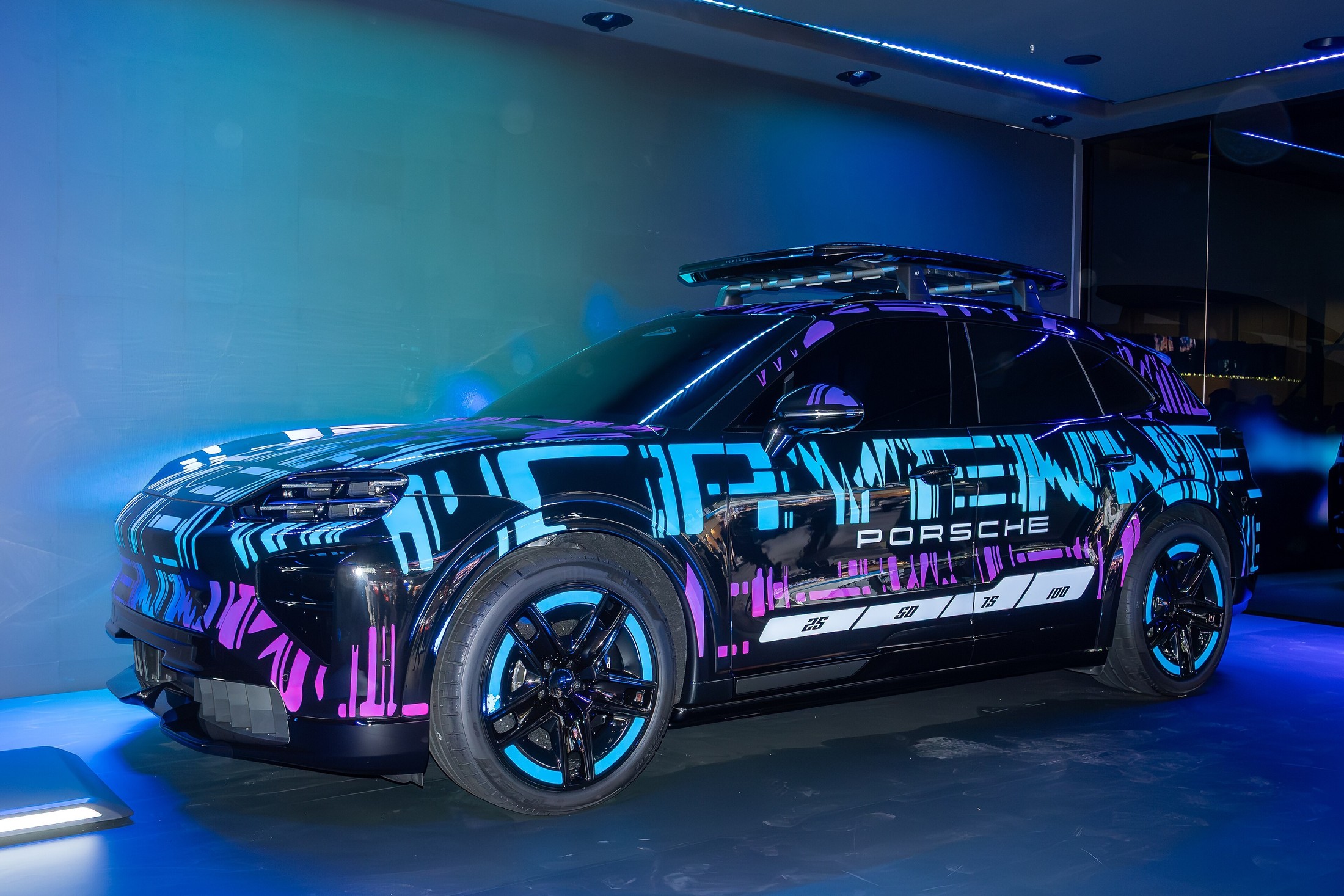
The Cayenne changed Porsche's structure after 2002. A sports car company that built an SUV drew criticism, but the model ended up supporting the brand. In 2026 the Cayenne became an electric car, and Porsche made the switch without a new nameplate: the Cayenne is still the Cayenne, only its power source has changed.
The car uses the Volkswagen Group's PPE platform with an 800-volt architecture and a battery of around 100 kWh. Charging peaks at 270 kW, taking the pack from 10 to 80 percent in roughly 16 minutes. The Turbo version produces more than 1,000 hp; the quickest variant reaches 100 km/h in around three seconds.
The body was shaped around drag. Active flaps at the front, a flat underbody and an extending rear spoiler work together for a drag coefficient of 0.25. Two-chamber air springs with adaptive dampers are standard, as is rear-axle steering. Carbon ceramic brakes are offered with 22-inch wheels.
Inside, a 12.6-inch curved instrument display, a 12.3-inch central screen and a 10.9-inch passenger display divide the functions. Porsche also offers an 11 kW wireless charging pad set into the garage floor, so the car charges by parking over it rather than by plugging in.
The challenge for the Cayenne Electric is not performance but familiarity. Its owners drive long distances, cross snowy passes and carry families. An electric SUV has to answer all of that with the same confidence. Porsche's focus on 800 volts, wireless charging and aerodynamics reflects a view of the problem as one of use, not of specification.
要点
- The Cayenne Electric is the battery-electric version of Porsche's SUV
- It uses an 800-volt architecture and a battery of around 100 kWh
- Charging at up to 270 kW takes the battery from 10 to 80 percent in about 16 minutes
- The Turbo version produces more than 1,000 hp
- Drag coefficient of 0.25 with rear-axle steering as standard
この記事に事実と異なる点があると思われる場合は、訂正・反論の手続きでご請求いただけます。ご連絡は press@mbent.co.kr まで。
次の記事 · MOTORS MCLAREN W1: 1,275 hp and 399 numbers →