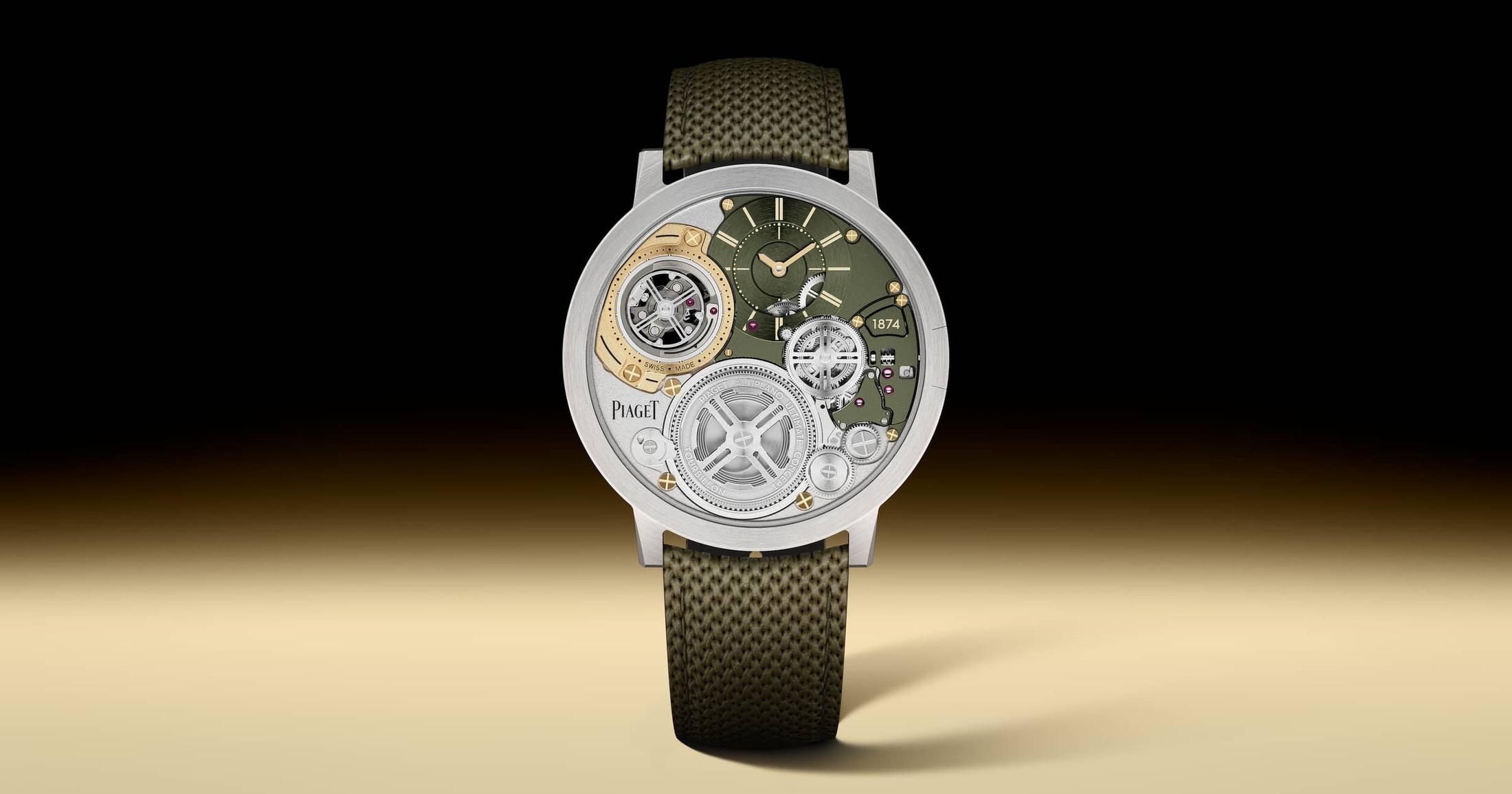
Piaget began in 1874 in La Côte-aux-Fées. In 1957 its 2 mm calibre 9P set the benchmark for ultra-thin watchmaking, and in 1979 it released a sports watch called the Polo. Polo was then the symbol of a aristocratic sport, and the watch's cushion case and horizontal dial grooves translated the saddle and the field into metal.
The current Polo Date keeps that shape with a recut case: 42 mm in steel, 9.4 mm thick. A cushion case carries a round bezel, reading as a circle from the front and a square from the side. Horizontal grooves are cut at regular intervals across the dial, a small date sits at 6, and hands and markers carry lume.
Calibre 1110P is automatic with 180 components, 25 jewels and 50 hours of reserve at 28,800 vph. CHOPARD's rival may chase records, but Piaget's house movement carries the ultra-thin inheritance in its bridge finishing and rotor shape. A sapphire case back is fitted, and water resistance is 100 metres.
The bracelet is steel with a folding clasp, tapering from the case so it wraps the wrist. Short lugs keep the 42 mm case from looking large, a proportion the Polo has held since 1979.
The US retail price is around USD 10,000. Piaget was long classed as a jeweller's watch house, and the Polo is the line where it keeps a place in steel sports watches. A watchmaker built on ultra-thin movements makes a sports watch that divides from the others on thickness: 9.4 mm is that difference.
أرقام أساسية
- Piaget was founded in 1874 and set an ultra-thin benchmark with the 2 mm calibre 9P in 1957
- The Polo was introduced in 1979 as a sports watch; the current Polo Date uses a 42 mm steel case 9.4 mm thick
- Calibre 1110P is automatic with 180 parts, 25 jewels, 28,800 vph and 50 hours of reserve
- The dial carries horizontal grooves and a date at 6 o'clock; water resistance is 100 metres
- The steel bracelet tapers from the case and uses a folding clasp
إذا رأيت خطأً في هذا المقال فيمكنك طلب تصحيح أو حق الرد عبر إجراء التصحيح. راسلنا على press@mbent.co.kr.
التالي · WATCH Piaget Altiplano Ultimate Concept: a watch 2 mm thick ←